Claude writes 90% of its own code. Anthropic has revealed a system that prevents AI from breaking the product.
Claude writes code, Anthropic's quality control system, automated change verification, improving development quality, efficient change management
The number of accepted changes has more than doubled over several months, while the share of changes that had to be reverted decreased by more than 40%. The company's engineers published a detailed description of the quality control system, specifically how the CI/CD and development process with Claude are structured. Let's dive in!
Why did traditional code review stop working?
The problem arose due to a massive increase in development volume.
In Anthropic's main repository, the number of changes merging into the main branch grew from approximately 2,500 per day in May to over 30,000 in September 2026.
Claude Code is developed in a separate repository, but the team faced a similar issue. When agents are capable of creating changes significantly faster than a human, traditional line-by-line review becomes a performance bottleneck.
Therefore, Anthropic changed the very goal of the review. Now, the focus is not on whether a human has read all the code, but on what errors might arise and the most effective way to detect them.
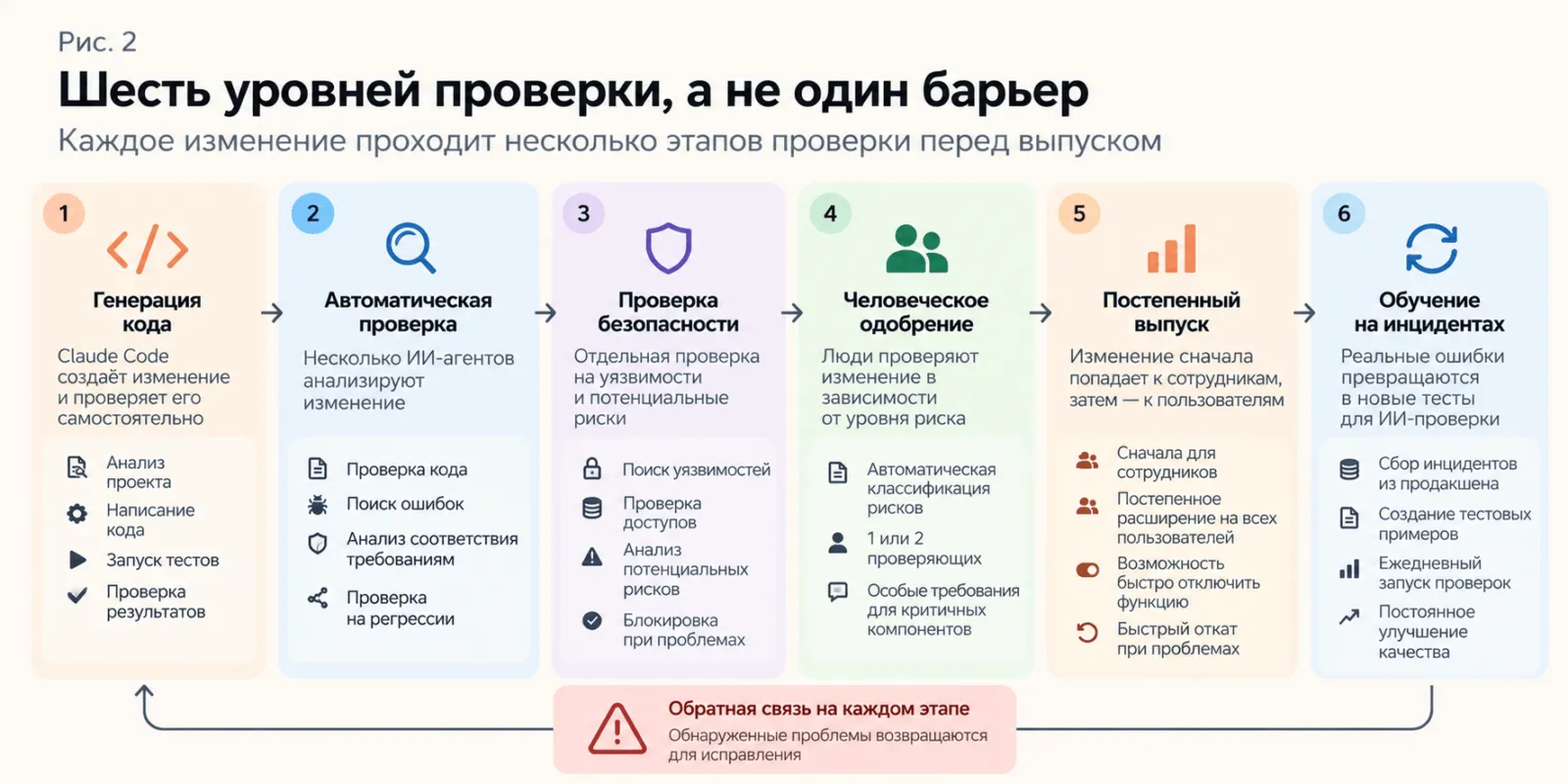
Phase One: Claude checks its own work
Most of the verification begins even before a pull request is created.
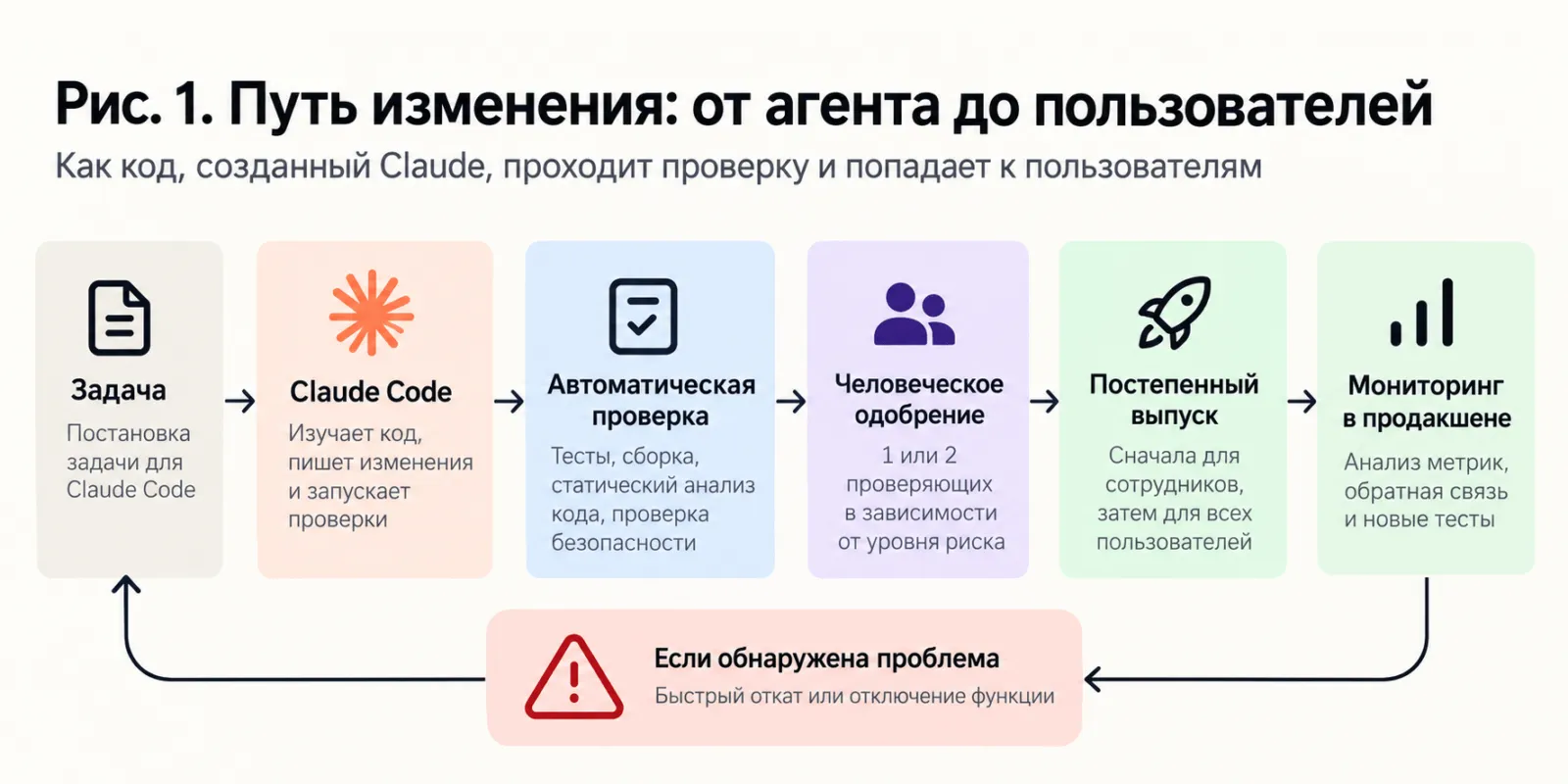
The agent receives a task, studies the project, writes the code, and runs available verification tools. These can include tests, application builds, static analysis, or comparing the UI against a reference image.
After this, a separate agent with an independent context analyzes the changes made.
Developers also utilize specialized Claude Code skills. One looks for bugs, another simplifies the code, and a third verifies the application's behavior as a whole.
According to Boris Cherni, the creator of Claude Code, the ability to self-verify results improves the quality of the final work by two to three times. This is his engineering estimate, not a universal result from an independent study.
Phase Two: Multiple AI agents search for bugs simultaneously
Every change request undergoes automated Claude verification.
The system examines not only the new lines but also the surrounding code, the purpose of the change, and its interaction with the rest of the project.
Several agents work in parallel to find logical errors, requirement violations, and potential regressions.
Then, another group of agents verifies the discovered issues. A comment is published only after additional confirmation.
This is how Anthropic attempts to reduce false positives. This is crucial, as an erroneous comment could force another agent to fix code that is already working correctly.
After implementing such a system, the share of internal change requests receiving substantive comments grew from 16% to 54%.
Phase Three: Separate security check
Changes undergo an independent vulnerability check.
If the system detects a potential security issue, merging the code into the main branch is blocked until it is resolved or the issue is justified and closed.
Standard automated checks are also mandatory. The system runs tests, type checking, static analysis, and builds on supported platforms.
For some changes, the number of individual checks can reach dozens.
Phase Four: Human involvement based on risk
Anthropic's most interesting solution is that not every change requires the same amount of human oversight.
Documentation, minor text fixes, and certain internal functions can pass without mandatory human approval, provided all automated checks are successful.
Standard product changes require one human reviewer.
The most critical changes require two reviewers. This includes specific sensitive components where an error could lead to serious consequences.
The risk category is determined by an automated classifier that analyzes the content of the change. Meanwhile, certain files always require human involvement.
AI approval never replaces mandatory human approval.
Phase Five: Code is released gradually and prepared for rapid rollback
Even after all checks, Anthropic does not consider code guaranteed to be safe.
Before merging changes, the system reruns checks against the current state of the main branch. This helps detect conflicts between changes that worked correctly in isolation.
New features are typically activated for Anthropic employees first.
Then, updates reach users through the main release channel, while a more stable channel receives them later.
If a problem is detected, the feature can be disabled via a special feature flag or the change can be reverted.
The speed of error detection and resolution has become a vital part of the quality system.
Phase Six: Errors turn into new tests for the AI
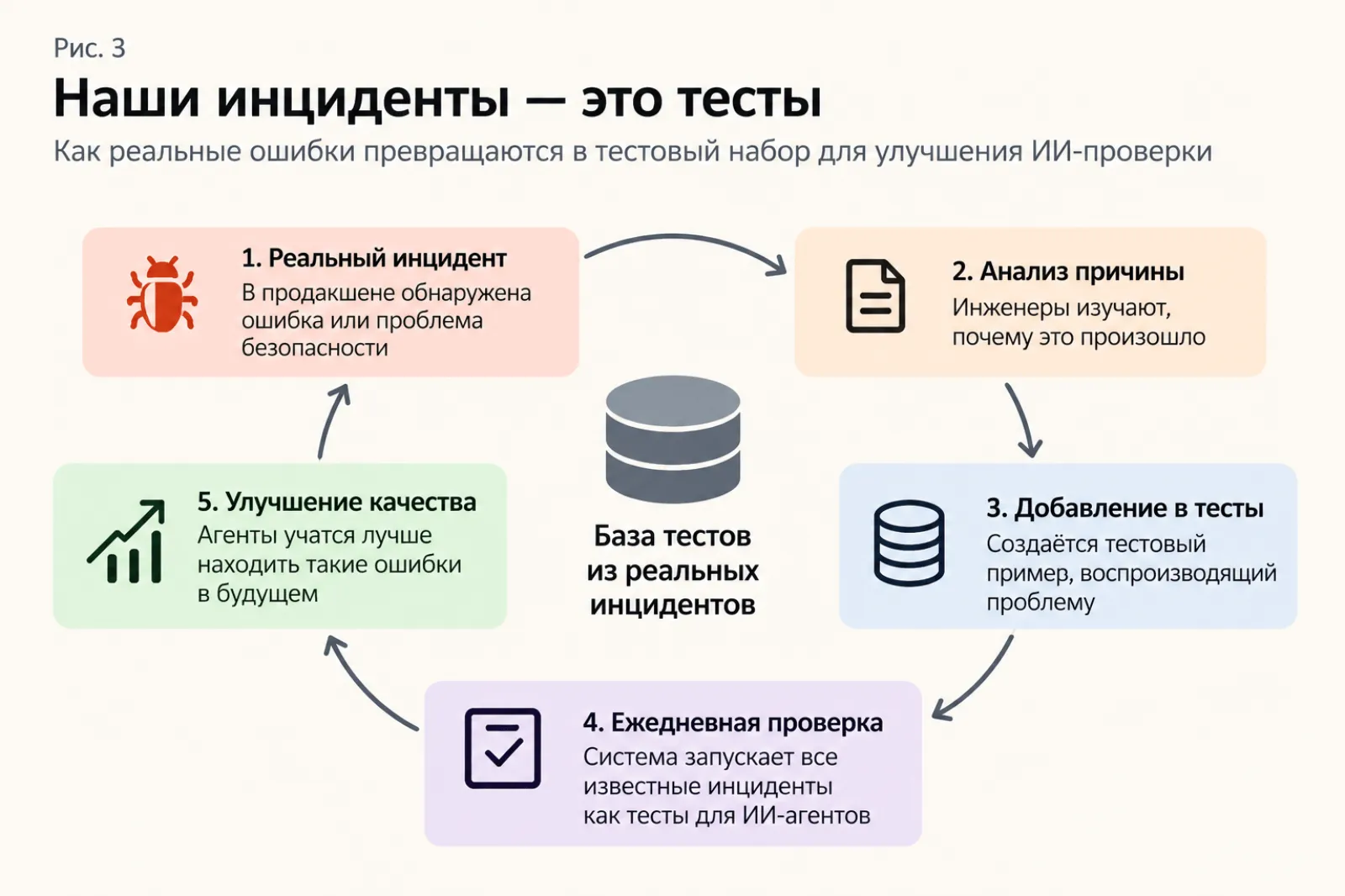
Anthropic uses real production incidents to continuously improve automated verification.
Engineers collect changes that caused errors in the past and use them to build a test suite.
Every day, the verification system runs against these examples. This allows the team to measure how well the agents detect known classes of problems.
However, automation revealed an unexpected downside.
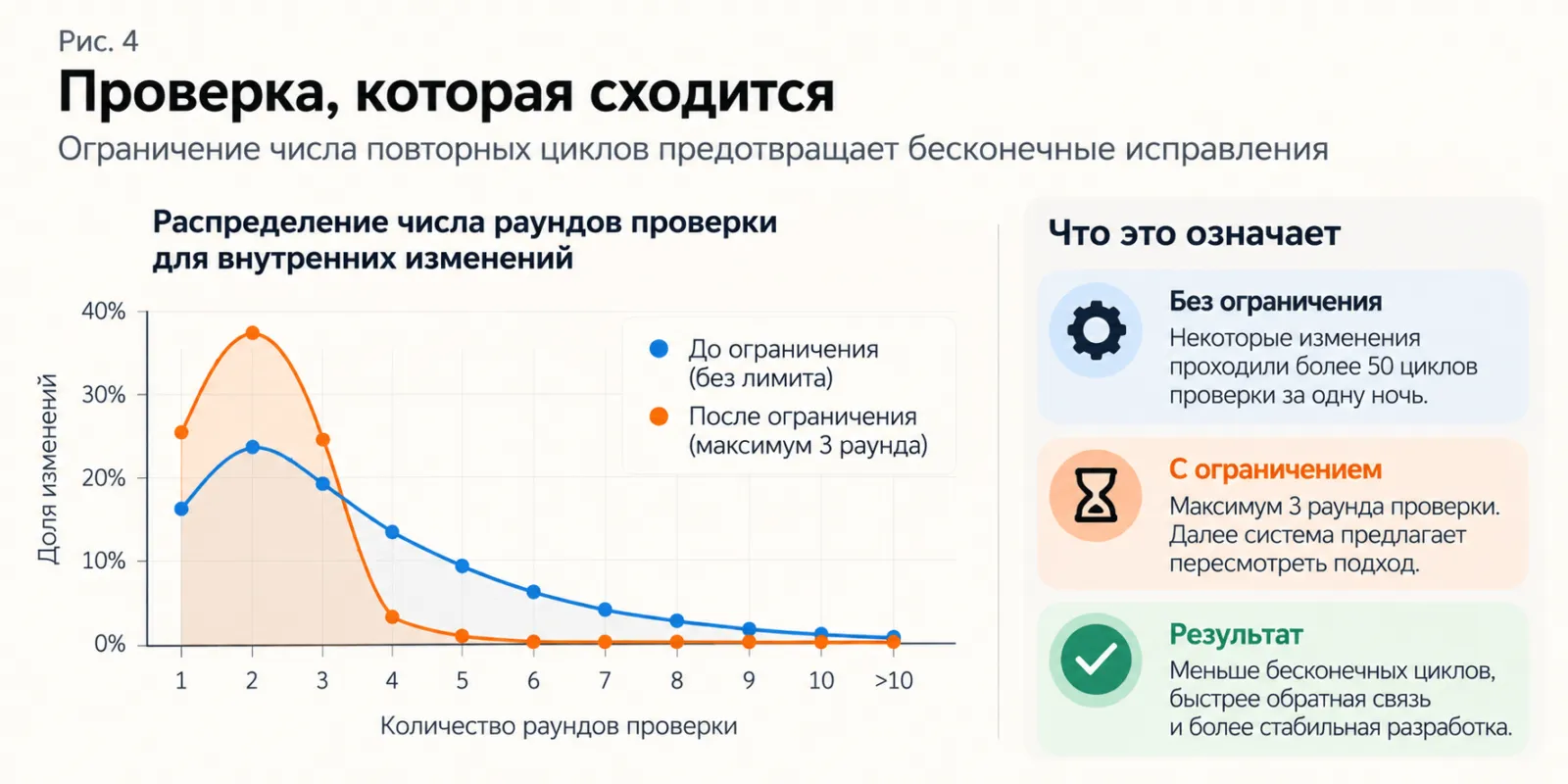
One change request went through more than 50 cycles of verification and correction overnight. Agents continued to find issues, fix them, and restart the verification process.
To stop such infinite loops, Anthropic limited the number of re-verifications. After three rounds, the system suggests rethinking the approach to the task itself.
What can developers learn from Anthropic?
The company published not only a description of its own process but also specific tools to replicate it.
The CLAUDE.md file is used to describe the project, architectural agreements, and available verification commands.
The REVIEW.md file sets the rules for automated analysis, including typical errors, sensitive components, and requirements for proving discovered issues.
The /code-review and /security-review commands allow for running additional checks, and integration with GitHub helps automate change analysis.
For the most critical components, Anthropic recommends maintaining mandatory human approval, even if automated checks pass successfully.
If you are interested in AI, technology, and the future—welcome to my channel to discuss and share updates.
Translated from Russian. Original on vc.ru: Claude пишет 90% собственного кода. Anthropic раскрыла систему, которая не даёт ИИ сломать продукт.