A digital fly decides which task you should start your day with! The Drosophila AI has found an unexpected use case.
A digital fly prioritizes tasks: a nervous system-based model, a task management app, innovative technology, and neurons.

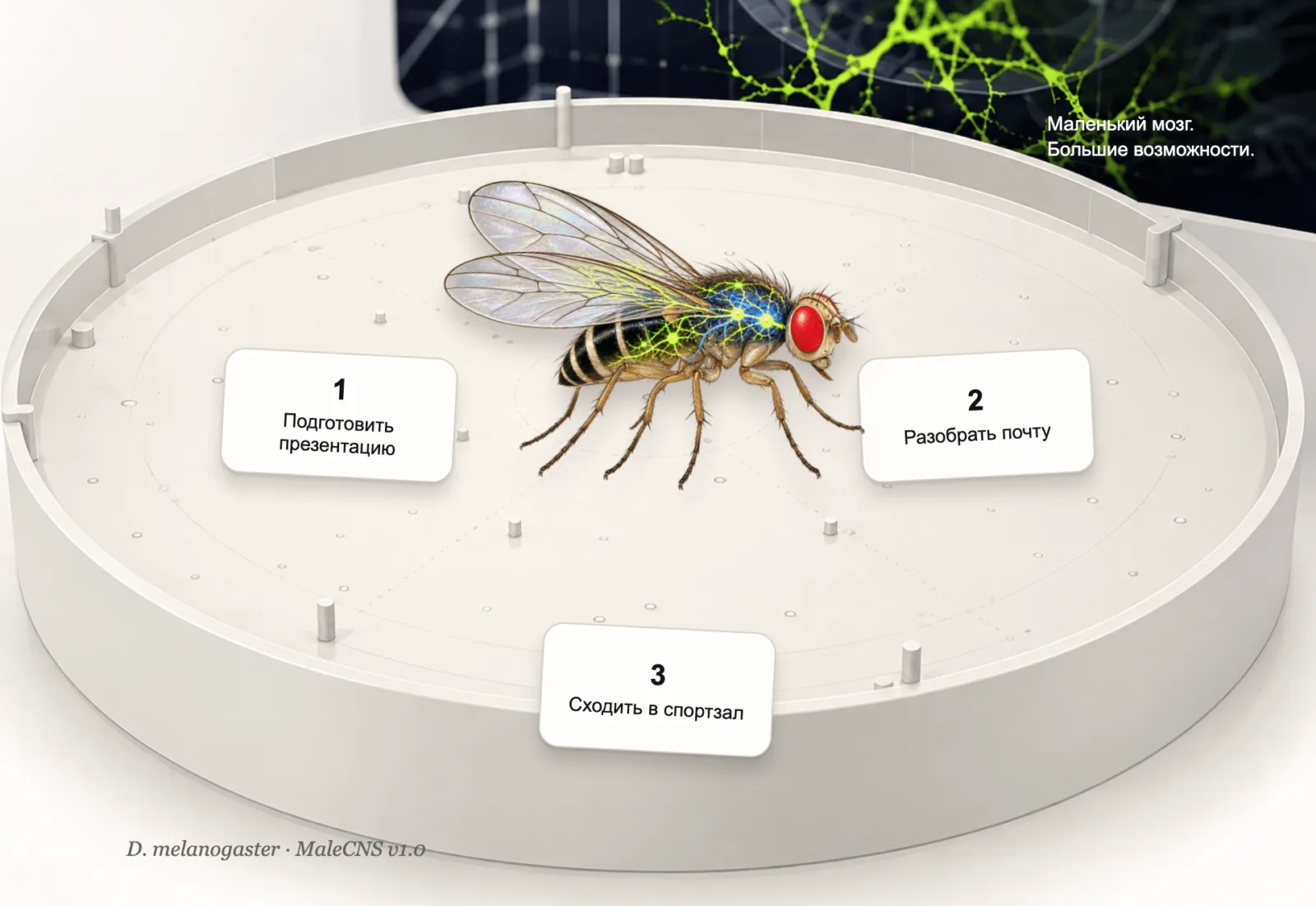
Developers have put together a web demo where a fly model, built on the actual circuitry of its nervous system, sets priorities in your to-do list. Enter up to 5 tasks, and you'll get one main priority and a list of what can be postponed. No, it's not a joke. Well, almost.
How does it work?
A user enters up to 5 tasks. The output provides one priority task, while the rest are moved to 'postponed.' The website's headline honestly asks: 'The fly decides: where to start?'
The result is formatted into a shareable card. If you want to follow through, the list can be transferred to MWS Tables, where tasks are organized by day.
What do neurons have to do with this?
The foundation of it all is the connectome: a complete map of the connections between neurons. In a Drosophila, this consists of about 140,000 neurons and 50 million synapses (according to FlyWire data). Over the past year, this map has turned into an open playground: you can download it and plug it into just about anything.
And in early September 2026, a map of the entire central nervous system of a male fly was also released: 166,700 neurons and about 125 million synapses, under a CC BY 4.0 license. The project was a collaboration between the HHMI Janelia Research Campus and Google Research. Immediately after the release, enthusiasts began plugging it into games.
What is the fly playing already?
The list is quite strange:
- DOOMFLY: gameplay frames stimulate sensory neurons, and the resulting activity is converted into controls. When the character takes damage, 'pain' is felt by several cells in the fly that are responsible for negative reinforcement;
- Fly64: the same connectome was plugged into Super Mario 64, though without any training or rewards;
- Beat Saber, Minecraft, and Tic-Tac-Toe on a 98-cell chain;
- Flyhard: fly neurons are learning to drive a car;
- DJ Drosophila: a 24/7 radio station where the music is 'spun' by connectome activity;
- A separate genre: trading. Stonkfly traded Bitcoin, though the author himself notes that 'profitable training has not been demonstrated.'
Parallel to this, there is serious science. The connectome has already been attached to a physical body model in the MuJoCo simulator. Reports suggest that such a virtual fly behaved realistically, even regarding feeding, and without any AI training on data.
What's the catch?
Most often, it's not the fly playing, but a small trainable layer sitting on top of the neurons. The connectome itself might just be a beautiful noise generator with the right structure.
For task prioritization, this means the following: the MWS announcement does not describe how task text is converted into a signal for the neurons, or why the winning task should be the most important one.
There is no proof that the fly performs better than a coin toss. As the enthusiasts in the list above would honestly admit: 'without the claimed advantage.'
What does this mean in practice?
It is too early to seriously trust a fly with your backlog.
But when you have five tasks and zero motivation, any external arbiter works like heads or tails: if the chosen option irritates you, you already knew what you actually wanted to do.
Your daily schedule is now being managed by an insect with 140,000 neurons. Managers, brace yourselves.
Would you trust a fly with your to-do list?
If you are interested in AI, technology, and the future—welcome to my channel to discuss and share updates.
Translated from Russian. Original on vc.ru: Цифровая муха решает, с какой задачи вам начать день! ИИ дрозофилы нашёл неожиданное применение.