Google introduces Harness²: AI can now improve itself without retraining
Google's Harness²: an AI self-optimization framework for improving tools, instructions, memory, resource access, and research software

An open framework that allows AI agents to independently refine their own operating configurations. Instead of modifying the neural network, the system optimizes the instructions, tools, memory, and other components that dictate the agent's behavior.
In experiments, this approach improved performance on professional benchmarks by up to 11.5 points without changing the model weights. The developers have released the source code on GitHub, making the technology available to researchers and engineers.
What exactly has the AI learned to change?
A modern AI agent is more than just a language model. To perform real-world tasks, it requires an entire system of auxiliary components. This system determines which tools are available to the agent, what information it remembers, how it delegates tasks, and which instructions it follows.
In development, such a system is called a harness.
Harness² allows for the automatic modification of eight of its components: system instructions, safety constraints, memory, tool usage guidelines, skills, scripts, additional agents, and plugins.
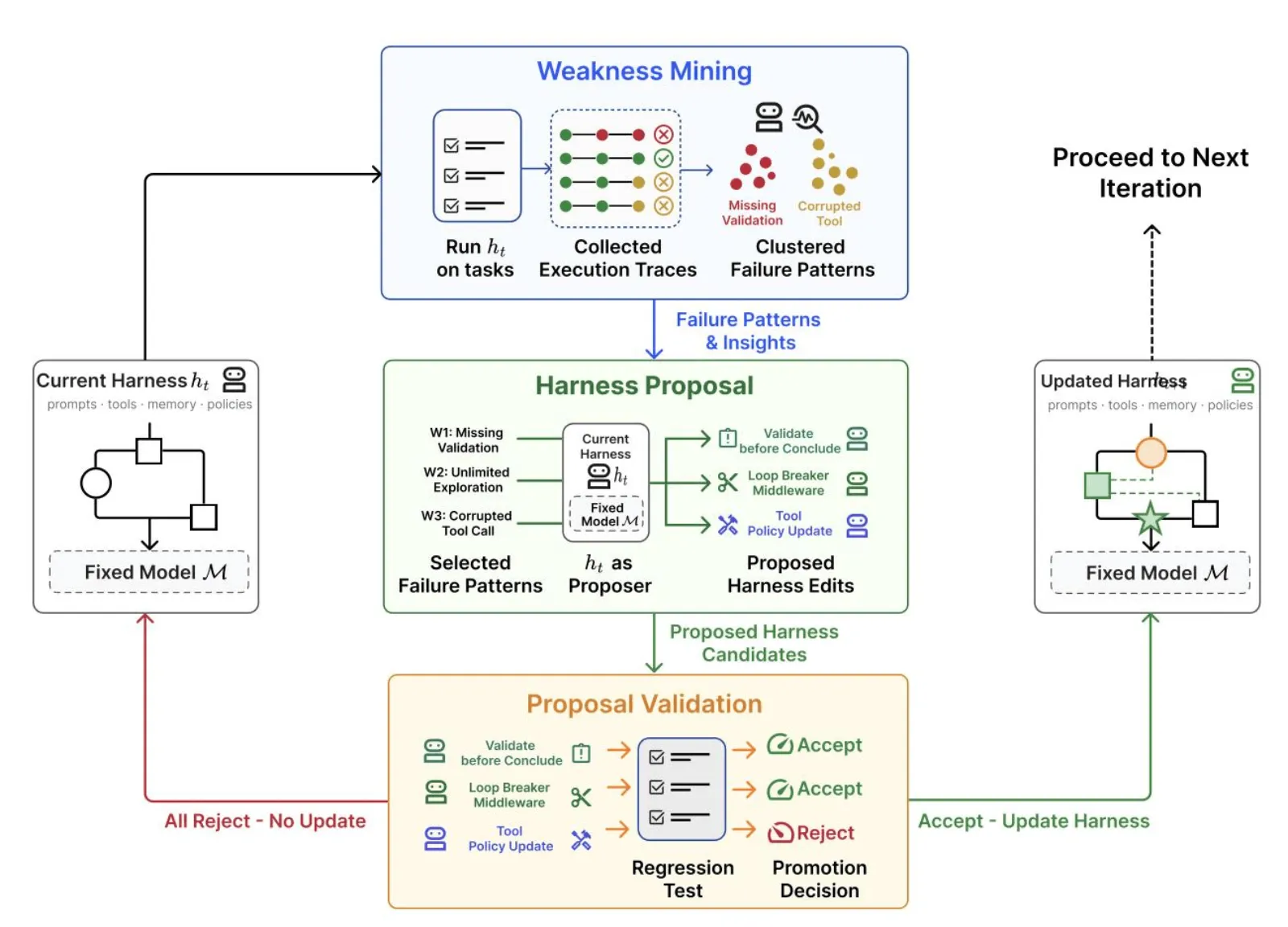
For example, if an agent regularly makes mistakes while performing a complex task, the system can suggest changing the sequence of actions, adding specialized instructions, or redistributng the workload among tools.
The fundamental difference from traditional training is that the neural network itself remains unchanged. It is the organization of its workflow that improves.
How does self-improvement work?
Harness² is based on two interconnected processes.
The first is responsible for specific tasks. The system proposes several variations for changing the working configuration, tests them in practice, compares the agent's behavior, and generates an improved version.
Researchers call this mechanism Propose, Probe, Compose. It allows for selecting improvements even when no ground-truth reference answer exists for a given task.
The second process is responsible for accumulating experience. After completing a task, the system saves successful changes and insights that may prove useful in the future.
In this way, the agent isn't just trying to solve a single problem better; it is gradually forming more efficient ways to handle new tasks.
At the same time, this is not about the uncontrolled modification of its own software. The framework works with a specific set of editable components and utilizes experimental verification of the proposed changes.
What did the tests show?
The authors tested Harness² on three professional task sets, including WorkBuddy Bench, JobBench, and the legal benchmark LAB.
The experiments utilized GLM 5 and Gemini 3.5 Flash models across several agentic environment configurations.
After one optimization stage, researchers recorded improvements of up to 11.5 points on WorkBuddy Bench, up to 4.5 points on JobBench, and up to 11.8 percentage points in the partial task completion metric for LAB.
These are the results of the authors' own tests, not proof that the system will work equally effectively with any agent. Additional optimization attempts also require computational resources and increase the cost of task execution.
Why does this matter for AI development?
Most of the competition in the AI industry is focused on creating more powerful models. Companies are increasing compute budgets, gathering new data, and refining training algorithms.
Harness² demonstrates a different path to increasing efficiency.
Even an existing model can solve more tasks if its tools, instructions, memory, and interaction processes with the external environment are improved.
This is particularly relevant for developers of software agents. The performance of Claude Code, Codex, and similar systems depends not only on the capabilities of the base model but also on how effectively file access, tool usage, result verification, and context management are organized.
In the long term, such technologies could reduce the amount of manual configuration required for agentic systems. However, automatic changes require safety controls, result verification, and access restrictions.
Where can you try Harness²?
The source code is published in the official Google Research repository. The project is distributed under the Apache 2.0 license and supports experimental work with OpenCode and Codex agentic environments.
A mode without a connection to a language model is provided for local demonstrations. More complex experiments require configuring the appropriate tools and environment.
It is important to note that Harness² is currently research software, not an officially supported commercial product of Google Cloud.
If you are interested in AI, technology, and the future—welcome to my channel to discuss and share updates.
Translated from Russian. Original on vc.ru: Google представила Harness². Теперь ИИ может улучшать себя без переобучения модели